
Applying it to close-fitting sleeves on masculine and feminine garments
The well-preserved pourpoint of Charles de Blois, found today in the Musée des Tissus in Lyon, France, has been remarkably under-studied by clothing historians. There exist many recopies of the original pattern diagram published by Adrien Harmand in his Jeanne d’Arc et ses costumes, son armure: Essai de reconstitution, from 1929, but very little detailed discussion of the tailoring techniques used to create this extraordinary garment.
One particularly noteworthy tailoring technique employed on this close-fitting garment is a two-section sleeve pattern that I like to call the “elbow hinge”, as it gives the wearer a skin-tight fit through the arm while maintaining built-in bendability at the elbow. The original Blois pourpoint’s sleeve pattern looks like this (if we’re to believe Harmand and all his copiers):
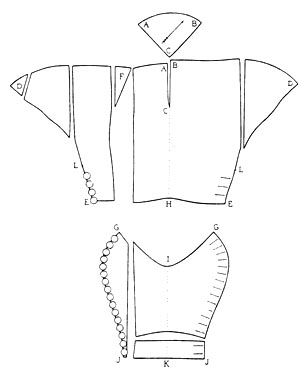
The top portion, the much-celebrated but little-understood grande assiette, is the subject of another article, The tailoring of the grande assiette. The bottom portion, however, is the focus here. It lends modern-day historical clothing sleuths a method for tightening our fashionably-buttoned late 14th-century sleeves while also providing built-in room to fully bend the elbow. The diagram below shows what the pattern would look like if you connect the two vertically-cut pieces and take out the wrist cuff, a tailoring element which can be added or left out, depending on one’s preferred time, place, and the gender of the clothing.
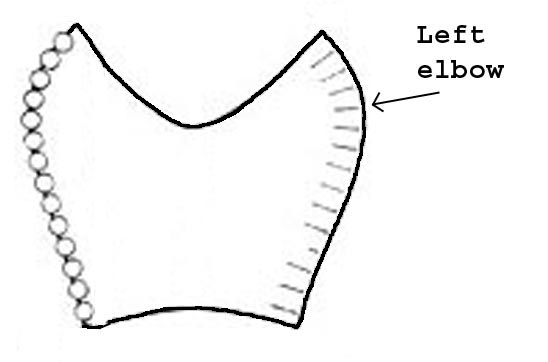
This piece (when adjusted for size and shape of forearm) attaches to the upper portion of a sleeve, and provides roomy space for the bent elbow. The pattern above is for the left arm, as the placement of the buttonholes on the right side will create a downward-facing flap over the buttons, seen often in the art of the times and also on the Charles de Blois pourpoint itself.

This is a back view of the left arm on the Charles de Blois pourpoint. The red dotted line makes clear how the pattern piece appears in 3-D form. Note the backward-facing (or downward-facing, depending on position of the arm) buttonhole flap.
To apply this patterning technique on any close-fitting sleeve with button closures, observe the following:
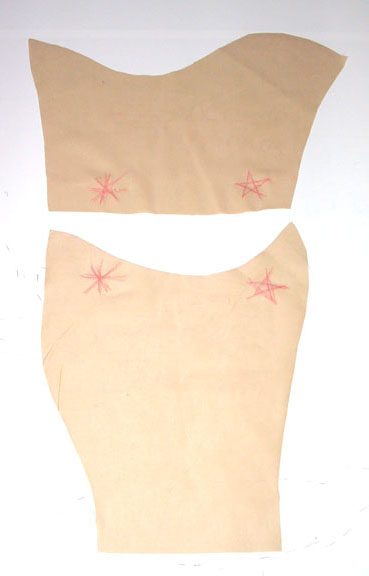
These pattern pieces are the result of fitting cloth directly on the left arm of Sheree, the model for the gown fittings found in this web site’s section on bust-supportive fitting techniques.
The top pattern piece is a typical s-curve sleeve cap, which means that the long seam traveling down the arm will begin on the back of the arm and go to just above the pointiest part of the elbow. This kind of tailoring allows the button closures to lay in the best place for fashionable visibility and the least physical impediment. The bottom piece is a real-life example of how differently-shaped someone’s arm can be in comparison to the original Charles de Blois pourpoint‘s lower sleeve pattern.
The stars and asterisks are recommended so that you can keep track of each side of the assymetrical pattern for the purpose of matching the pieces to each other.
For the straight-front-seam dress I sewed for Sheree, we decided on tight, buttoned sleeves. To get an exact match to her arms, I pinned fabric around her arms:


The final sleeve pattern, when pinned/sewn together, looked like this:
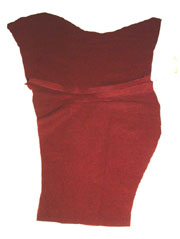


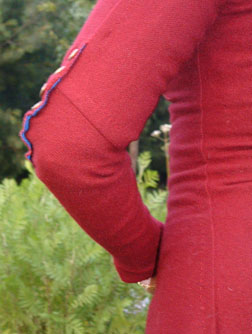
The picture on the left above is the inside view of the sleeve pieces connected at the elbow. The middle picture is the general shape of the sleeve, with the vertical seam pinned. The last picture is the back view of the sleeve, also pinned and clearly showing the accommodation of the elbow.
The final sleeve works nicely and does not draw a lot of attention to the horizontal seam across the middle of the arm.

7 thoughts on “The “elbow hinge” tailoring of the Charles de Blois pourpoint”
This is really helpful and interesting. I’m trying to work up a re-sizable pattern to offer custom built gambesons and will definitely take your ideas here into account.
Best of luck!
Thank you for the how-to! I tried to create a sleeve with an elbow hinge for my kirtle, but although the cloth fits perfectly and snugly over my elbow when my arm is fully flexed, when I straighten it there is a pronounced bulge at the elbow. There are some photos of how it looks on my blog> http://edralis-blogging.blogspot.sk/2013/07/hinging-sleeve.html . I’m not sure whether this is just a part of the design, or if I should fit the elbow little less roomily. If you happen to find a little time to check the photos out, I would be glad for any advice. 🙂
Hi Mineta, from the pictures on your blog, I would recommend cutting out some of the ball-like portion on the side with the larger extension. Yes, it’ll be slightly less roomy with a fully-bent arm, but it ends up being a bit of a trade-off. More mobility than you’d get with a tight sleeve otherwise, but a little bit of pooching when the arm is straight. I suspect that if women’s dresses truly used this technique (haven’t technically found evidence for it yet, myself), they had to deal with the same issues you are dealing with. Best of luck!
Pingback: Late 14th Century Supportive Dress (Gray Linen) – Susanna Herst
Pingback: 1360’s Englishman’s Cote – Susanna Herst
Pingback: Random musings on HEMA jacket sleeve design: the elbow hinge – sillynewsboy